
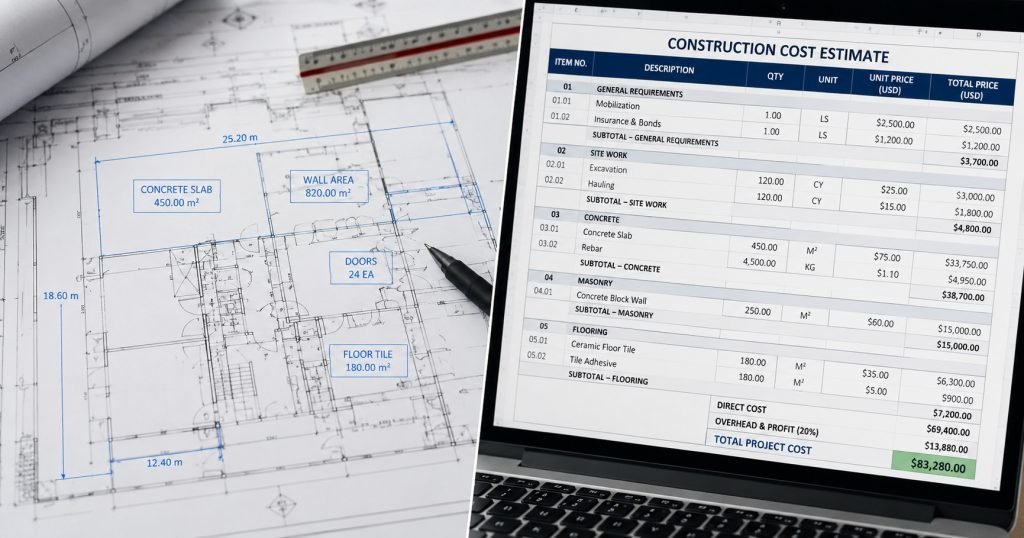
If you are new to construction estimating, two terms you will come across frequently are material takeoff and cost estimate. Although they are closely connected, they serve different purposes in the construction estimating process.
A material takeoff determines how much material is required for a project. A cost estimate takes those quantities and applies current pricing, labor, equipment, subcontractor costs, overhead, and other applicable costs to determine how much the project is expected to cost.
Understanding the difference is important for contractors, subcontractors, builders, quantity surveyors, and project managers preparing bids or budgets in the USA, Australia, Canada, and other construction markets.
Material Takeoff vs Cost Estimate: Quick Answer
The simplest way to understand the difference is:
Material Takeoff = How much is required?
Cost Estimate = How much will it cost?
The material takeoff generally comes first. Once reliable quantities have been measured from the construction drawings, those quantities can be priced to develop a detailed cost estimate.
What Is a Material Takeoff?
A material takeoff, also called a quantity takeoff or construction takeoff, is the process of reviewing construction drawings and identifying the quantities of materials required to complete a defined scope of work.
The estimator measures areas, lengths, volumes, and individual units from the available drawings and organizes the results by trade or material.
Depending on the project, a material takeoff may include:
- Concrete quantities
- Reinforcement steel
- Formwork
- Framing lumber
- Drywall and sheathing
- Roofing materials
- Flooring and tile
- Doors and windows
- Paint and coatings
- Electrical materials
- Plumbing materials
- HVAC materials
For example, an estimator may determine that a project requires a certain number of cubic yards of concrete, square feet of drywall, linear feet of framing, or a specific number of doors.
At this stage, the primary focus is quantity rather than price.
What Is a Construction Cost Estimate?
A construction cost estimate uses the quantities identified during the takeoff and applies appropriate pricing to them. It provides a financial picture of what it may cost to complete the project.
A detailed construction estimate can include several different cost categories, including:
- Material costs
- Labor costs
- Equipment costs
- Subcontractor costs
- Delivery and freight costs
- Project-specific indirect costs
- Overhead
- Contingency allowances
- Contractor markup and profit
For example, if the material takeoff identifies the required quantity of concrete, the cost estimate can apply a current unit price to that quantity and then account for labor, equipment, delivery, and other applicable costs.
This turns a quantity-based takeoff into a financial estimate that can be used for budgeting, bidding, or project planning.
Material Takeoff vs Cost Estimate: Key Differences
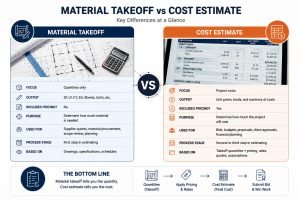
| Material Takeoff | Cost Estimate |
|---|---|
| Focuses on quantities | Focuses on project costs |
| Measures and counts materials | Prices quantities and other project costs |
| Primarily based on drawings and specifications | Uses quantities, pricing, labor rates, quotes, and project information |
| Usually contains no dollar values | Contains unit prices and calculated costs |
| Used for supplier pricing and procurement | Used for bidding, budgeting, and project cost planning |
| Usually comes earlier in the estimating process | Usually follows the quantity takeoff |
In simple terms, the material takeoff provides the quantity data, while the cost estimate converts that information into financial information.
How Material Takeoff and Cost Estimate Work Together
A material takeoff and a construction cost estimate are not competing documents. They are two connected stages of the estimating process.
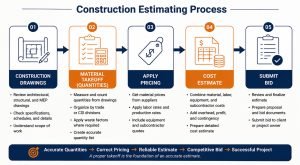
A typical workflow looks like this:
- Review the construction drawings and project specifications.
- Measure and count quantities for each trade or scope.
- Organize the takeoff by material, trade, unit, and quantity.
- Obtain supplier and subcontractor pricing where required.
- Apply labor rates and production assumptions.
- Add equipment and other applicable costs.
- Account for overhead, contingency, and profit according to the estimating strategy.
- Compile the final cost estimate for bidding or project planning.
This sequence is important because pricing an incorrect quantity can lead to an inaccurate estimate, even when the unit prices themselves are correct.
Why the Takeoff Comes Before the Estimate
Reliable estimating starts with reliable quantities.
Suppose a project actually requires 2,000 square feet of flooring, but the estimator uses 1,700 square feet when preparing the estimate. Even if the material price and labor rate are accurate, the final estimate will still be understated.
This is why professional estimators generally begin with the drawings, establish the quantities, review the scope, and then move into pricing.
A good takeoff helps reduce quantity-related errors before they affect the final bid.
What Information Is Used to Prepare a Material Takeoff?
The information required depends on the project type and scope, but estimators commonly review:
- Architectural drawings
- Structural drawings
- MEP drawings
- Construction details
- Schedules
- Project specifications
- Finish schedules
- Door and window schedules
- Equipment schedules
- Applicable addenda and revisions
For digital projects, estimators may also use PDF drawings, CAD files, and other electronic project documents.
The quality and completeness of the documents can have a direct impact on the reliability of the quantities.
What Information Is Needed for a Cost Estimate?
A cost estimate requires more than measured quantities. The estimator also needs appropriate pricing and project assumptions.
Depending on the project, this may include:
- Material unit prices
- Current supplier quotations
- Labor rates
- Production rates
- Equipment rates
- Subcontractor quotations
- Delivery and freight costs
- Project location
- Construction schedule
- Site conditions
- Scope inclusions and exclusions
- Overhead and profit requirements
Pricing should be reviewed for the specific project location and market conditions rather than relying on outdated or generic rates.
When Do You Need a Material Takeoff?
A material takeoff is especially useful when the main objective is to understand the physical quantities required for the work.
Contractors may need a takeoff when:
- Requesting supplier quotations
- Comparing material prices from different suppliers
- Planning material procurement
- Checking quantities against another estimate
- Preparing a subcontractor scope
- Planning project materials before construction
- Reviewing drawings for quantity-related scope gaps
A contractor may also outsource the takeoff while keeping the pricing and final bidding strategy in-house.
When Do You Need a Cost Estimate?
A cost estimate is required when the project team needs to understand the expected financial cost of the work.
Common situations include:
- Preparing a construction bid
- Developing a project budget
- Comparing project options
- Preparing a client proposal
- Reviewing project feasibility
- Planning financing requirements
- Comparing subcontractor bids
- Monitoring expected project costs
In many bidding situations, both documents are needed: the takeoff establishes the quantities and the estimate applies pricing to those quantities.
Material Takeoff, Cost Estimate, and BOQ: How Are They Different?
Material takeoffs and cost estimates are also closely related to the Bill of Quantities (BOQ), but the three should not automatically be treated as the same document.
Material Takeoff
The takeoff primarily answers:
How much material or work is required?
Cost Estimate
The estimate primarily answers:
How much is the project expected to cost?
Bill of Quantities
A BOQ is a structured document that organizes measured work items, units, quantities, and, depending on its use, rates and amounts. BOQs are commonly associated with formal tendering and quantity surveying workflows.
For a detailed explanation, see our guide on What Is a BOQ in Construction?
Common Mistakes Contractors Make
1. Estimating Without Completing the Takeoff
One common mistake is trying to price a project before the quantities and scope have been properly reviewed.
Experience is valuable, but relying entirely on memory or rough assumptions can cause important quantities to be missed.
2. Treating a Takeoff as a Finished Quote
A material takeoff is not normally a complete client-facing price. It provides quantities that can be priced to develop an estimate or bid.
If a client needs to know the expected project cost, a properly structured cost estimate is more appropriate.
3. Ignoring Waste and Project Conditions
Some materials require allowances for cutting, breakage, offcuts, installation patterns, or other project conditions.
The appropriate allowance depends on the material and project rather than applying the same percentage to every item.
4. Using Generic Pricing Without Reviewing the Location
Construction pricing can vary significantly between regions. Labor, materials, transportation, subcontractor availability, and local market conditions may all affect the final cost.
A project in Texas may require different pricing assumptions from a project in New York, Sydney, or Melbourne.
5. Failing to Review Drawing Revisions
Using outdated drawings can create quantity and pricing problems. Before finalizing an estimate, the estimator should confirm that the latest drawings, specifications, and applicable addenda have been reviewed.
Can You Outsource the Material Takeoff but Prepare the Estimate Yourself?
Yes. This is a practical approach for many contractors and subcontractors.
A contractor may outsource the time-consuming quantity measurement work and then use the completed takeoff to apply their own supplier prices, labor rates, overhead, and profit strategy.
This approach can be particularly useful when a contractor has several bids due at the same time and wants to reduce the amount of time spent measuring drawings.
Do You Need Both a Material Takeoff and a Cost Estimate?
For many construction bids, yes.
However, the level of detail depends on the project and its purpose.
A small renovation may use a combined spreadsheet containing quantities and prices. A larger commercial tender may require a more detailed workflow where the takeoff, supplier quotations, subcontractor pricing, and final estimate are developed and reviewed separately.
The important point is that the estimating process should match the project’s size, complexity, documentation, and bidding requirements.
Frequently Asked Questions
What is the main difference between a material takeoff and a cost estimate?
A material takeoff identifies the quantities required for the project, while a cost estimate applies pricing and other costs to determine the expected financial cost of completing the work.
Does a material takeoff include prices?
A basic material takeoff normally focuses on quantities and does not include final dollar values. Pricing can be added later when preparing a cost estimate or procurement document.
Can a material takeoff be used to prepare a construction estimate?
Yes. The quantities from a material takeoff are commonly used as a key input when preparing a construction cost estimate.
Can the same estimator prepare both documents?
Yes. Many construction estimators handle both quantity takeoff and cost estimating. On larger projects, different team members may handle quantity measurement, pricing, quantity surveying, and final bid review.
Can I outsource only the material takeoff?
Yes. Contractors can outsource quantity takeoff services and use the completed quantities to prepare their own pricing and bid.
What software is used for material takeoffs and cost estimating?
Digital takeoff work may be performed using tools such as PlanSwift, Bluebeam Revu, or On-Screen Takeoff. Cost estimates may be organized in Microsoft Excel or construction estimating platforms, depending on the contractor’s workflow and project requirements.
Need a Material Takeoff or Construction Estimate?
Accurate quantities are an important starting point for reliable construction estimating. Whether you need a material takeoff for supplier pricing or a detailed construction estimate for bidding, the work should be based on the latest available drawings and project documentation.
We provide material takeoff and construction estimating services for residential and commercial projects across the USA, Canada, and Australia, covering a wide range of construction trades.
Send your project drawings and let us prepare organized quantity information or a detailed estimate based on your project requirements.
Request a Free Sample Takeoff or Estimate →