

If you work in construction estimating, tendering, or project management, you have probably come across the term BOQ. But what is a BOQ in construction, and how is it different from a material takeoff?
A Bill of Quantities (BOQ) is a structured document that breaks a construction project into measurable work items, showing descriptions, units, quantities, and, where applicable, rates and amounts. It gives contractors and project teams a consistent basis for pricing, tendering, procurement, and cost control.
BOQs are particularly common on commercial, infrastructure, government, and larger construction projects. Their format and measurement practices can vary between countries and project types.
In this guide, we’ll explain what a BOQ is, what it includes, how it is structured, how it differs from a material takeoff, and how contractors can use accurate quantities to prepare more reliable bids.
What Does BOQ Stand For in Construction?
BOQ stands for Bill of Quantities.
A BOQ is generally prepared from construction drawings, specifications, schedules, and other project documents. The work is divided into measurable items so contractors can review the scope and apply their own pricing.
Depending on the project, a BOQ may include items for:
- Sitework and earthworks
- Concrete and foundations
- Reinforcement
- Masonry
- Structural steel
- Framing and carpentry
- Roofing
- Doors and windows
- Drywall and ceilings
- Flooring
- Painting
- Plumbing
- HVAC
- Electrical work
- External works
The exact structure depends on the project, contract requirements, measurement standards, and local industry practices.
What Is a Bill of Quantities?
A Bill of Quantities provides a structured breakdown of construction work into measurable line items.
A typical BOQ identifies:
- What work is required
- How the work is measured
- How much work is required
- The unit used for measurement
- The rate or unit price
- The resulting amount
For example, a concrete item might be measured in cubic yards or cubic metres, while wall finishes may be measured in square feet or square metres.
A tender BOQ may provide the descriptions and quantities while leaving the rate and amount columns for contractors to complete. An internal estimating BOQ may already contain pricing.
This makes the BOQ more than just a list of materials. It is a structured measurement and pricing document used to organize the scope of a construction project.
What Does a BOQ Include?
The exact columns can vary, but a typical BOQ may include the following information:
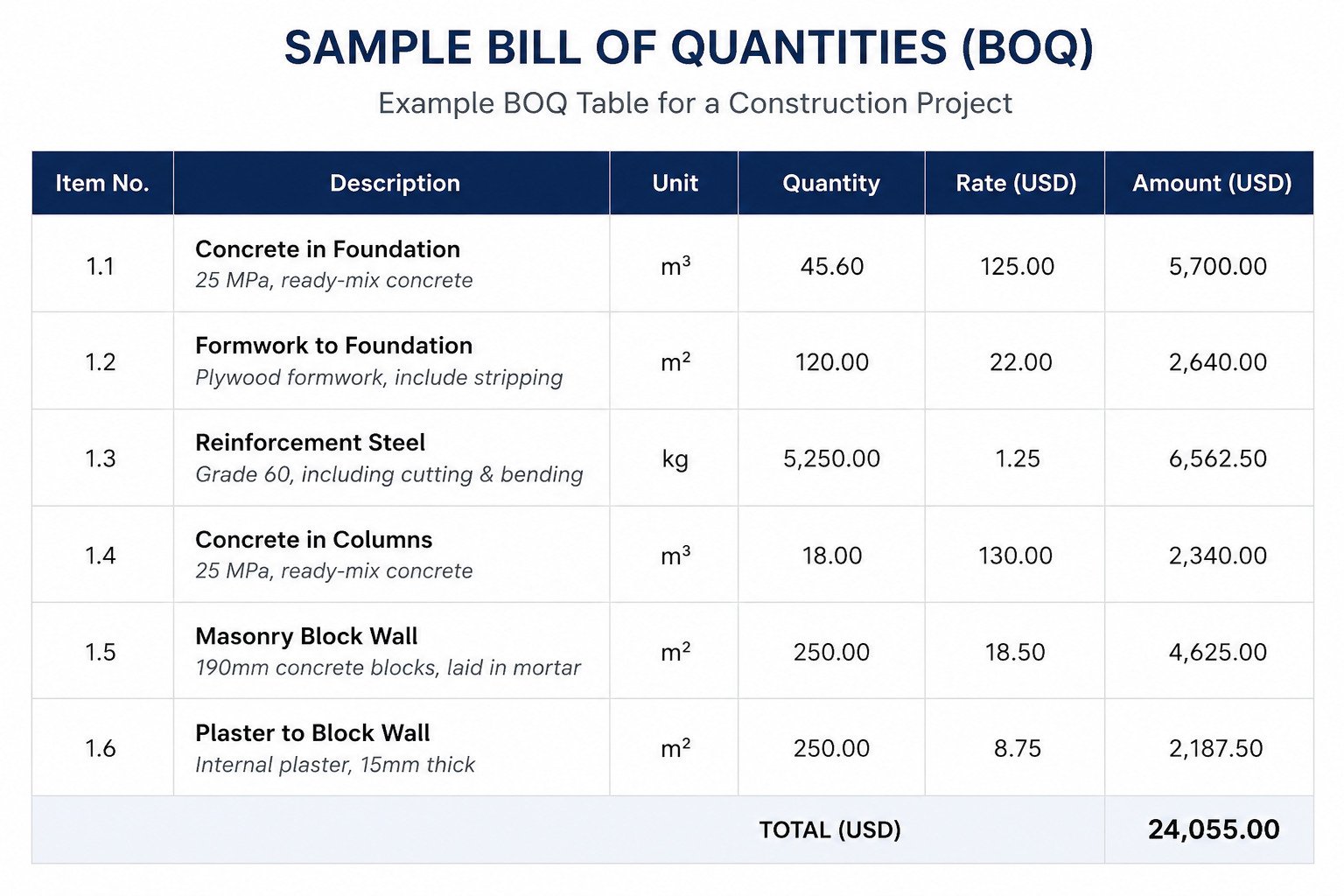
| Column | What It Contains |
|---|---|
| Item No. | Reference number for the work item |
| Description | Description of the work, material, or installation |
| Unit | Unit of measurement such as m², m³, SF, LF, or EA |
| Quantity | Measured quantity from the project documents |
| Rate | Unit price for the work item |
| Amount | Quantity multiplied by the applicable rate |
For example:
| Item | Description | Unit | Quantity | Rate | Amount |
|---|---|---|---|---|---|
| 1 | Concrete footings | m³ | 25 | — | — |
| 2 | Reinforcement steel | kg | 2,800 | — | — |
| 3 | Formwork to foundations | m² | 180 | — | — |
| 4 | Concrete slab | m³ | 42 | — | — |
| 5 | Blockwork | m² | 320 | — | — |
The quantities in a BOQ normally come from measurement of the project documents. The rate and amount depend on the pricing approach and who is using the BOQ.
How Is a BOQ Structured?
A well-organized BOQ divides the project into logical work sections. This makes it easier for contractors, subcontractors, estimators, and project teams to review the scope and price the relevant items.
Common sections can include:
Preliminaries
Preliminaries may include project-related requirements such as:
- Mobilization
- Site setup
- Temporary facilities
- Site supervision
- Temporary works
- Insurance and project requirements
Sitework and Earthworks
This section may include:
- Site clearing
- Excavation
- Backfilling
- Grading
- Soil removal
- Drainage
- Underground utilities
Concrete and Foundations
Typical items include:
- Footings
- Foundation walls
- Slabs
- Columns
- Beams
- Reinforcement
- Formwork
Masonry
Depending on the project, masonry work can include:
- Concrete masonry units
- Brickwork
- Mortar
- Lintels
- Reinforcement
- Associated accessories
Structural Steel
Structural steel sections may include:
- Beams
- Columns
- Bracing
- Plates
- Connections
- Bolts
Framing and Carpentry
Typical items include:
- Wall framing
- Floor framing
- Roof framing
- Sheathing
- Headers
- Engineered lumber
Roofing
Roofing quantities may cover:
- Roof coverings
- Underlayment
- Flashings
- Ridge and hip components
- Gutters
- Downpipes
Doors, Windows and Glazing
This section may identify:
- Door types
- Door quantities
- Window types
- Window quantities
- Glazing systems
- Hardware requirements
Interior Finishes
Interior work can include:
- Drywall
- Ceilings
- Flooring
- Painting
- Wall finishes
- Millwork
Mechanical, Electrical and Plumbing
MEP sections may include:
- Plumbing fixtures
- Pipework
- HVAC equipment
- Ductwork
- Electrical fixtures
- Conduit
- Wiring-related quantities
BOQ vs Material Takeoff: What Is the Difference?
A material takeoff and a Bill of Quantities are closely connected, but they serve different purposes.
A material takeoff primarily focuses on measuring and counting quantities from construction drawings. A BOQ organizes measurable work items into a format that can be used for tendering, pricing, and project administration.
| Material Takeoff | Bill of Quantities |
|---|---|
| Focuses on quantities | Focuses on structured work items and quantities |
| Starts primarily from drawings | Uses drawings, specifications, and project information |
| Commonly used for estimating and procurement | Commonly used for tendering and pricing |
| May focus heavily on materials | Can include broader work activities |
| Pricing may be separate | Often includes rate and amount columns |
A simple way to think about it is:
Material Takeoff = What quantities are required?
BOQ = How are those measurable work items organized for pricing and tendering?
The two can overlap significantly, and the exact distinction depends on the project and the company’s estimating workflow.
For a more detailed explanation of quantity measurement, see our guide on
Material Takeoff in Construction.
Who Prepares a BOQ?
The person responsible for preparing a BOQ depends on the project and contract requirements.
Quantity Surveyors
Quantity Surveyors frequently prepare or manage BOQs on larger commercial, infrastructure, and public-sector projects, particularly in markets where quantity surveying is a standard part of the procurement process.
Construction Estimators
Estimators may prepare BOQs as part of the bidding and estimating process, particularly when contractors need a detailed breakdown of project quantities before applying costs.
Engineers and Project Professionals
On smaller or owner-managed projects, engineers, project managers, or other construction professionals may prepare structured quantity schedules.
Outsourced Estimating Professionals
Contractors may also outsource BOQ preparation when their internal team is busy, when a tender has a short deadline, or when additional estimating capacity is needed.
Why Is an Accurate BOQ Important?
Accuracy matters because the BOQ can become an important reference point during bidding and project cost management.
Avoiding Underbidding
If quantities are underestimated or important work items are missed, a contractor may submit a bid that does not fully cover the expected scope.
Reducing Overbidding
Overstated quantities can make a tender unnecessarily expensive and may reduce the contractor’s competitiveness.
Supporting Supplier Pricing
Clear quantities help contractors request more useful supplier and subcontractor quotations.
Improving Cost Control
A structured BOQ makes it easier to organize project costs and compare pricing across different work sections.
Supporting Variations
On contracts where the BOQ forms part of the contractual documentation, measured items can help establish a reference for evaluating changes or variations.
Improving Progress Tracking
Depending on the contract structure, BOQ items may also be used to help measure completed work and support progress payment assessments.
An accurate BOQ does not guarantee that a project will be profitable, but it provides better quantity and scope information for making pricing decisions.
BOQ in Australia vs USA
The basic concept of a Bill of Quantities is similar across construction markets, but the way projects are measured, documented, and procured can vary.
BOQ in Australia
BOQs are commonly associated with quantity surveying and are used on many commercial, infrastructure, and public-sector projects.
Measurement practices may follow Australian industry standards and project-specific documentation requirements.
Metric units such as:
- m
- m²
- m³
- kg
- tonnes
BOQ in the USA
In the USA, project documentation and estimating practices can vary significantly by project type and contract method.
Commercial and institutional projects may use structured divisions and specifications, with CSI MasterFormat commonly used as an organizational framework.
Estimators may work with units such as:
- SF
- LF
- CY
- SY
- EA
It is important not to assume that every American or Australian project uses exactly the same BOQ format. The contract documents, client requirements, measurement method, and procurement approach should determine the final structure.

How to Prepare a BOQ: Step by Step
1. Collect the Project Documents
Start with the available project information, including:
- Architectural drawings
- Structural drawings
- MEP drawings
- Specifications
- Schedules
- Details
- Addenda and revisions
- Relevant project reports
2. Review the Scope
Before measuring anything, understand the overall project scope and identify which trades and work sections need to be included.
3. Complete the Quantity Takeoff
Measure areas, lengths, volumes, and individual items from the drawings and supporting documents.
This is where a detailed quantity takeoff becomes an important input to the BOQ.
4. Organize the Work Items
Group the measured quantities into logical sections and create clear line items.
5. Write Clear Descriptions
Each BOQ description should provide enough information for the person pricing the item to understand what is included.
Avoid vague descriptions such as “concrete work” when the project requires separate measurable items.
6. Assign the Correct Units
Use the appropriate unit for each item. An incorrect unit can make an otherwise accurate quantity difficult to price correctly.
7. Check Quantities Against the Drawings
Review the quantities against plans, elevations, sections, details, schedules, and specifications.
8. Add Pricing Where Required
For a tender BOQ, contractors may enter their own rates.
For an internal estimate, the estimator may apply material, labor, equipment, subcontractor, and other relevant costs.
9. Review and Issue the BOQ
The final document should be checked for missing items, duplicate quantities, inconsistent units, and obvious scope gaps before it is issued.
Common BOQ Mistakes to Avoid
Even a well-designed BOQ can create problems if the underlying information is inaccurate or incomplete.
Missing Scope Items
Important work can be overlooked when drawings and specifications are not reviewed together.
Incorrect Units
Using SF instead of SY, LF instead of EA, or another incorrect unit can create major pricing problems.
Unclear Descriptions
A vague description can lead different contractors to interpret the same item differently.
Duplicate Quantities
The same work may accidentally appear in multiple sections, causing the project quantity to be overstated.
Outdated Drawings
Using superseded drawings can result in quantities that no longer match the current project scope.
Inconsistent Measurement
Different areas of the project should be measured using a consistent approach appropriate to the project requirements.
No Final Review
A BOQ should be checked before it is used for tendering, pricing, purchasing, or contract administration.
What Software Is Used to Prepare a BOQ?
The software used depends on the project, company, and estimating workflow.
Microsoft Excel
Excel remains widely used for organizing quantities, rates, calculations, and BOQ schedules.
Bluebeam Revu
Bluebeam can be useful for reviewing PDF drawings and performing digital measurements before transferring quantities into an estimating or BOQ spreadsheet.
PlanSwift
PlanSwift is commonly used for digital quantity takeoffs across a range of construction trades.
Other Estimating and Project Platforms
Larger companies may use specialized estimating, quantity surveying, or project-management platforms depending on their workflow.
The software itself does not determine the accuracy of a BOQ. The quality of the drawings, measurement method, scope review, and estimator’s work remain critical.
Frequently Asked Questions About BOQ in Construction
Is a BOQ required on every construction project?
No. BOQs are more common on projects where a detailed measurement and tendering document is useful or required. Smaller residential projects may instead use simpler estimates, schedules, or pricing formats.
What is the difference between a BOQ and a schedule of rates?
A BOQ contains measured quantities for a specific project.
A schedule of rates generally provides agreed or reference unit rates for different types of work without necessarily containing the complete quantities for one defined project.
Can BOQ preparation be outsourced?
Yes. Contractors, builders, and construction companies can outsource BOQ preparation to professional estimators or quantity surveying providers when they need additional capacity or specialist support.
What software is used for BOQ preparation?
Excel is widely used for BOQ schedules, while digital takeoff and estimating platforms such as Bluebeam and PlanSwift can help with the measurement stage.
Is a BOQ the same as a material takeoff?
No. They are related but serve different purposes. A material takeoff focuses primarily on measuring quantities, while a BOQ organizes measurable work items into a structured format commonly used for pricing and tendering.
Who prepares a BOQ?
Depending on the project, a BOQ may be prepared by a Quantity Surveyor, construction estimator, engineer, project professional, or an outsourced estimating specialist.
Need a Professional BOQ for Your Project?
A well-prepared BOQ can give contractors a clearer picture of project quantities and provide a more organized foundation for tender pricing.
At AccuroBuild, we provide construction estimating and quantity takeoff support for contractors, builders, and construction professionals working across the USA, Canada, Australia, and other markets.
Our estimating support can help with:
- Detailed quantity takeoffs
- Bills of Quantities
- Trade-specific estimating
- Residential estimating
- Commercial estimating
- Material quantity measurement
- Tender and bid preparation
If you have construction drawings ready, send them to our estimating team and we can help turn the project information into an organized quantity and estimating document.